
This week I went on what we might call a ‘workcation’1 – where you venture to a place that is separate from home/familiar surroundings with a purpose of engaging in activities that straddle an ambiguous boundary between work and pleasurable affiliation.
As I mentioned in my previous post, a lot of my research stems from a sense of joy; I have always buried myself wholly and completely in multiple historiographical pursuits. I mean, the first book I remember reading so much, cover to cover, that the cover and pages were earmarked, frayed, and worn in was about Greek mythology and the origins of the pantheon. I won’t digress too much (spoiler alert: too much nostalgia), it should be clear that history has been a part of my lifepath for, well, ever.
Overall, my motivation of studies or invested “labor” has always been via the pleasure of raising questions. The reason I foreground this information here is because I do think present generations of students have a different scope of what “research” is – and that it’s something thrusted upon them, without choice or direction. When I teach the research component in my writing classes, it is never surprising (or disheartening a bit) to see how students have been demotivated to enjoy the process. And when you try to instruct them that there is quite a lot of freedom in theme-centered courses, they are often anxious and concerned about the capacities they have… because they don’t imagine themselves as what they’ve told “researchers look like.” When talking to my students, I always stress and overly emphasize the importance of the relationship they have with research; they should imagine not simply a productive, efficient connection with things or ideas they’re pursuing, but they should genuinely perceive these ideas, concerns, and/or concepts with a desire to want to know or search for more.
And it also helps that I present this information in two key manners: my own history with research and an overly enthusiastic attitude.
First, yes, there are limitations to the kind of history that I provide to my students. For example, I do some sex and sexuality-based research within the scope of my field; while I grew up in a sexually liberated household that does not necessarily make it easy for me to impart these sensitive topics onto students, even to model conducting research! So, I try my best to frame other ‘safer’ topics when modelling this framework for students – i.e., consulting different masked dances in Mexico and how ‘femininity’ is consulted or determined via the mediation of a mask; the different kind of experiences that emerge from examining key structures during the Classic Period, like a temple atop a pyramidal structure; or women-centered labor, like weaving or managing the household, and rethinking what “work” looks like. The influence underlining these topics or other crucial research avenues have been certainly NSFW – like Juana María Rodríguez’s recent publication, Puta Life and asking us to think about exploring what ‘work’ looks like or is.
An effective way to facilitate “safer” and less personal information to students is to look and ask for student examples! In my program, we’re fortunate to have access to a breadth of student writing samples that fulfill different criteria; when I first started teaching, this was helpful to have access to, especially given that I had only encountered very specific, specialized art-based writing that seemed minimally applicable to what I was going to be teaching. Another great resource was those returning to teaching in the program; I learned a great deal from having mentors who were willing to share and collaborate. If these are not viable options (a la “um, I am a first-year grad student?! Hello?”), I always Googled or sought out experiences of what it was like for others to do research and finding their “thing.” In the end, it always seems like motivation happens through an array of directives – some things just “came easy,” they appreciated the stability/efficiency of specific topics, or they just randomized a Wiki page – but it often comes down to raising questions. Poking at things, searching for a response or stimulus for why things or some thing is the way it is.
The second part, which is entirely just personal and me… I have plenty of fun being active, cheerful, and in a positive mood when I teach! I build good rapport with my students on day one each quarter; having returning students makes the ‘bonding’ go a bit quicker – word gets around, students whisper about X teaching style and Y is lenient about due dates (sometimes – life happens!) – but I always relay to students that my authority in the classroom is to lead, direct, facilitate, and pivot conversations amongst one another. I may have some ground rules (which I can share, if it is of use for anyone that is on the other end of this ephemeral space…), but I maintain a sense of flexibility in how discussion, conversation, or activities can wind up. I find that students will grovel and act grumpy if you are not present; when I have off days, my students know it and are aware it isn’t their fault. But I always live by the idea that, if you connect with only one or two students who are jovial, happy, eager through having an open disposition and willingness to communicate, then it is totally worth it. And I always manage to have fun with students because they always throw surprises my way!
So, I have talked about how I approach Research™ with my students. The next part that immediately follows this discussion is always, “Okay, but where to begin?”
While you might have a handful of initiative-taking students who have a topic or idea they’re going to charge towards, it seems common that students won’t really know where to start. Teaching is entirely scaffolding; you illustrate and practice a pattern so they’ll familiarize themselves with these components enough that they will build a routine. Modeling helps quite a bit; but having some ‘fallback’ solutions to guide them along the way can benefit even the most ‘shrugging’ student to find their way.
Outlining the multitudinous ways of approaching “the research process.”
Once students have already developed a hypothesis of what research is, I offer them a really vague and open definition of research. This is often like saying “Research is basically a way to source and ‘validate’ answers for a research question.”
I put validate in quotes because my field has quite a bit of subjective qualities to it than, say, my physics students. But language is key to reducing their skepticism to my more liberally applied metrics of illustrating and demonstrating what research is. When I say validate, I elaborate that students should be able to source material that will demonstrate their perspective or position when they develop an argument; this does not mean that they can make any kind of recommendation in their argument without having something that is supporting their position. Rather, I ask them to elaborate and explain why their sources or cited material is providing an understanding to their approach or its application within the context of their argument and writing.
Example: I had a student who was doing a visual analysis of Get Out and had to focus on the use of space to produce an emotional effect. Their proposal was something like, “I want to argue that the depiction of the Sunken Place from Get Out is a visual metaphor of a personalized bystander effect, creating a sense of helplessness and inescapability.”
Yup – totally all for that! My response: what is the evidence you are using to support this claim? What is going into your analysis and interpretation of the Sunken Place that will validate and flesh out this proposal?
More questions will follow this proposal process, with plenty of back and forth between the student and myself! Like, does music elevate that sense? Why is it important to visually analyze the sound choice with the scene? What kind of angles/perspective are operative here? Do you think, for example, this scene is calling to a history of horror/thriller film tropes that are meant to create that sensation? How important is it that the viewer is seeing this happen to our presumed protagonist? Why/Is it important to acknowledge the Blackness of our male protagonist?
However, getting back to my initial concern regarding defining research – it is crucial that students are focused on finding ways to develop their argument through the support and foundation of other material. So, the key here is that they understand that research requires them to be in conversation with others. I then provide some guidelines for how they could interpret and interact with that definition of research. Always useful to have other insight, right? Here, I will use some of the materials from when I instructed students into disability studies research and adjacent studies for a creative group project.
Furthering what the ‘boundaries’ are. Research can then be…
… “describing phenomena.” Examples might include:
- “Why do we use X term instead of Y?”
- “How have autism and other neurodivergent disabilities been documented in the U.S. within the last 100 years?”
- “Why is it significant to modify ableist language in federal environments and documentation?”
- “How did the Americans with Disability Act change primary school classrooms?”
… examining relationships between/among phenomena. Examples might include:
- “What are the consequences/outcomes2 of differentiating between ‘visible’ and ‘non-visible’ disabilities?*
- “How does media coverage of the Olympics and Paralympics provide insight to visibility and representation of disabled athletes/athletes with disabilities?”
- “Why significant differences are there between disabled veterans & military service members during WWII and the Iraq War?”
- “How is disability represented in U.S. films vs. Mexican films?”
… proposing a theory to understand and simplify complex realities. Examples:
- “How have disability studies scholars from Global South perspectives – such as Ato Quayson – offered new insights to Global North/Western disability studies scholarship?”
- “What happens or could happen when we re-articulate and re-imagine what disability is?”
… investigating materials and sources to reach new conclusions/findings within a field and/or discipline. Examples:
- “If we synthesize disabilities studies using an abolitionist framework – rooted in Ruth Wilson Gilmore’s carceral work – what could disability studies mean for a non-academic and/or activist audience?”
By giving examples of the kind of questions that can be explored through research, students are encouraged that there are different ways to frame the process. One thing that I always manage to do that seems to be effective is modifying this information based on course-related material; I know it puts more of a burden on me to come up with new material each course and quarter that I teach, but this seems to be a great way for students to see the research-in-action. I tell students that my examples are meant to be educational and instructional, never the “end” result that they could aim for; it’s quite easy for students to simply look at your question(s) and go, “Hey… this seems like it’ll be _______, I’ll just use this one.” I believe that it’s normal for students who are not accustomed to individuating their own investigations (especially many of mine, who come from secondary education systems that gives them specific objects/questions – like those provided by AP exams) and are a little hesitant to dive into topics they’re minimally interested in at best or disengaged/apathetic with at worst.
So, yes, you might give them the framework to build within, but it’s easy to inform them that they are responsible for the structure from that point on. As an instructor, it’s vital to partially facilitate and participate in watching it grow and evolve, but the students should be managing the project and individuating it based on the response or feedback they receive from outsiders.3
Offering a foundation to developing their research process – creating a research question.
Students are often quite unaware that they can propose some really great and insightful research questions; most of the time, I have students who are really elated when they recognize that they have already done “the hard part” in thinking of a question that will motivate their research and investigation. I think a lot of this boils down to there being some discrepancies between what they’ve informed of what a research question looks like, modeled by other researchers operating within their field and the notion that they must immediately “fill a gap” in their respective field.
I grapple with what I call the ‘indoctrination’ via the rigidity of standardized writing systems – as a former survivor of the AP schema, it took me quite some time to unlearn the “rules” that seem to develop in these systems. As I mentioned previously, I am a fierce advocate of “killing the five-paragraph essay structure,” and I know it’s an easy system to fall into when time constraints are a factor. Why not use a familiar outline when you only have like, a week and a half to turn around a draft to have ample time for feedback and revision?4 But I find that there is a lot of unlearning that happens in between the first meetings in the classroom to the students’ respective writing software; it’s up to me as their facilitator to really guide the ability to move beyond a structure of writing that no longer benefits them, despite its advertisement as a “one size fits all” structure.
Getting back to the dilemmas of a research question – a lot of this is individualized and I often spend class time working through each student’s interests or proposed focus. Sometimes the idea of a “research question” is just that – an idea! It can be effective to let students know that these kinds of questions can take time to parse and work with because writing is a lot like a conversation, right? Some can form and deepen immediately; some can be awkward and make you want to step back, walk away from. Other times they just… fizzle and you’re not actually certain why that happens – it kind of just leads nowhere. But students should be encouraged to welcome those failures as much as they celebrate their triumphs! I have many papers that lost their lives as I trudged my way to a different path, as many as I have fantastic analyses of things I wasn’t even aware I was remotely invested in. They should, above all, be interested and curious about the topics, themes, ideas, concerns, notions, methodologies, etc. they are going to challenge.
Well, how do you propose a “research question” then?
As I mentioned before, research questions don’t have to be in the format of a question – at least not initially. They might form organically after writing through a problem or concept, but often it is inspired by something that motivates them to go further than just a surface-level inquiry. However, the eventual “foundational question” here should be rather open-ended that allows them to investigate in multiple ways, avenues, and directions. For example, if a student is interested in thinking about a consequential outcome of an event, was it always predicated as so? If something is consequential for a group of individuals or communities, why is it specifically a harmful/negative outcome for that group and its circumstances?
Research questions should be research with an intent (purpose).
Here is where I offer the following questions to students if they’re actively pursuing something or perhaps, they’ve stagnated, hit a wall. It helps them to take notes, so I give them this time to free write some general ideas for themselves to guide their process when, maybe, they’re not in the classroom and feeling the constraint of time.
- What do you want to investigate?
- Why do you think this is something you want to pursue further?
- What do you think will come out of such an investigation/inquiry?
- Who will be impacted by your research/investigation? Are these benefits or consequences? What considerations do you need to be mindful of when developing this inquiry?
- Are there limitations to what you’re proposing? Will it negatively impact your proposed research and investigation?
- How might you incorporate these limitations? What adjacent/related concerns should you prioritize in this pursuit?
When I ask these questions, I also provide a mapping of example open-ended questions that leads to more questions that I would take into consideration. For students, I will demonstrate a more ‘personalized’ mapping of something I could have done in the past. One example that I provided to students was something I used in a speculative art practice/theory class, where we formed a project that worked through the problems of teleology. My proposal was a curated art exhibit before a cataclysmic world-ending event – this was an “end of life as we know it” event and I had to create a traveling exhibit that could be experienced by a variety of participants, hosted throughout the world. I find it important to preface this information, because if I just provided the map of the research question & supplementary questions, I know I’d get a lot of “… girl –” looks. And I tell my students I have done this process before! So, they get a little relieved that I’m not immediately demanding they do what I do; I am showing them how I do it.
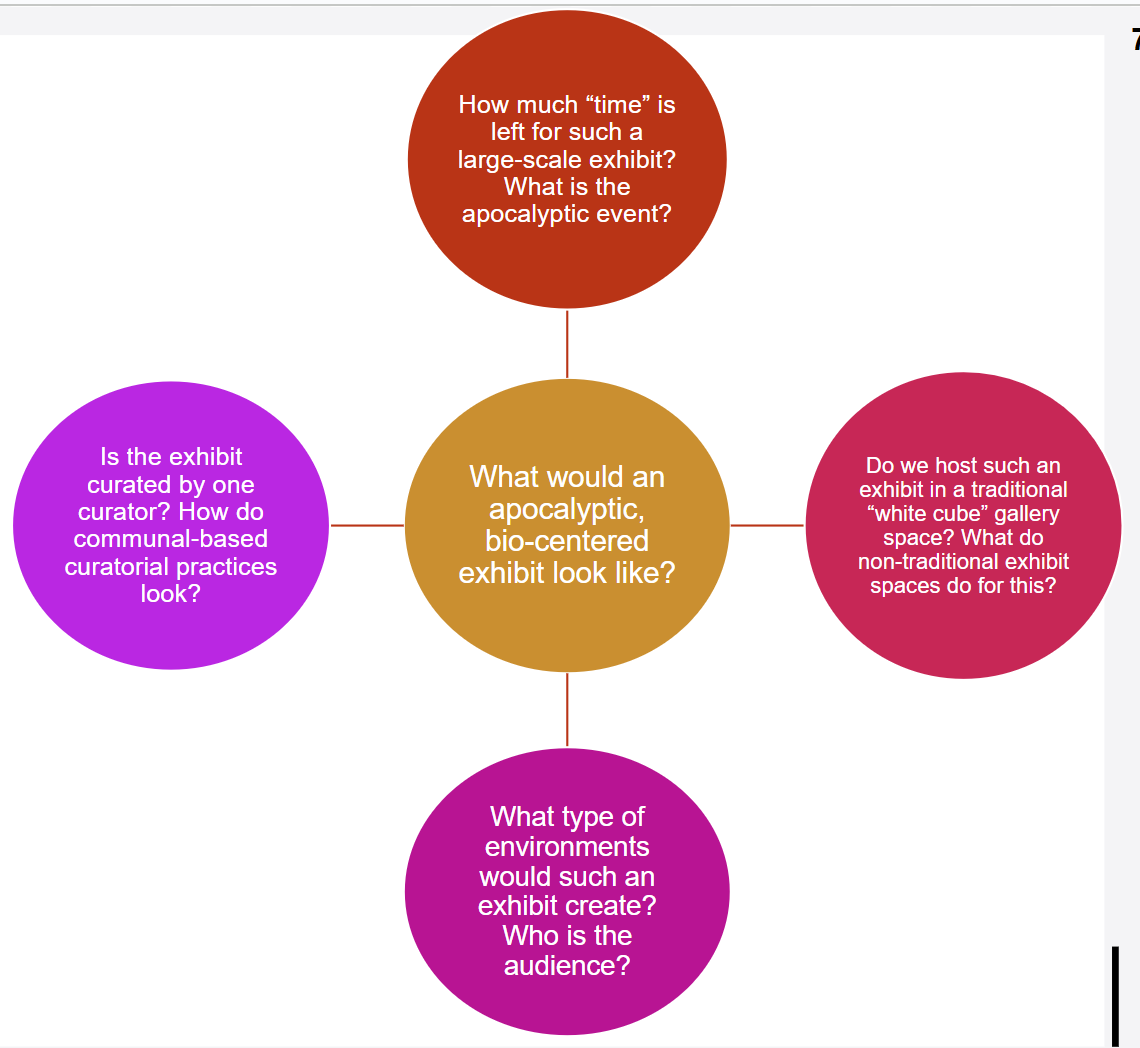
As I walk them through the mapping, I illustrate how the central question is centered around the visuals and the presentation of that exhibit. As my background is in art history & theory, my limitations are clear that I need to prioritize an interdisciplinary experience for all kinds of people, different information, and contrasting approaches that can take that into consideration. So, as I developed the project itself, I had to really prioritize seeking feedback from people who had other field specializations and backgrounds/upbringings. It was interesting to solicit feedback from friends, family, colleagues, and strangers on what would be interesting to “see one final time” before the end of our lives! But students needed to see this modeled and in practice so they could see a demonstration of what was directing the research and what still required development and focus.
After that modeling, I propose something that is more course dependent. I will also flex the things that I know – art, art history, museum/curatorial practices, history, specific theories/methodologies! – that will benefit them. I find they are much more interested in this part, because it’s like seeing something they could potentially replicate as they move into the actual “work” component of their research. Either way, I always find this makes me a much more flexible and adaptable instructor in the classroom; by modifying material to outside just something I want to do, I am being a student to my students that, hey, we must do it sometimes too – the stuff that’s a little less fun than our own pursuits! And in the years that I have been teaching, doing these things has made it quite easy for me to think on my feet in the classroom when I encounter student questions that are brand new each time.
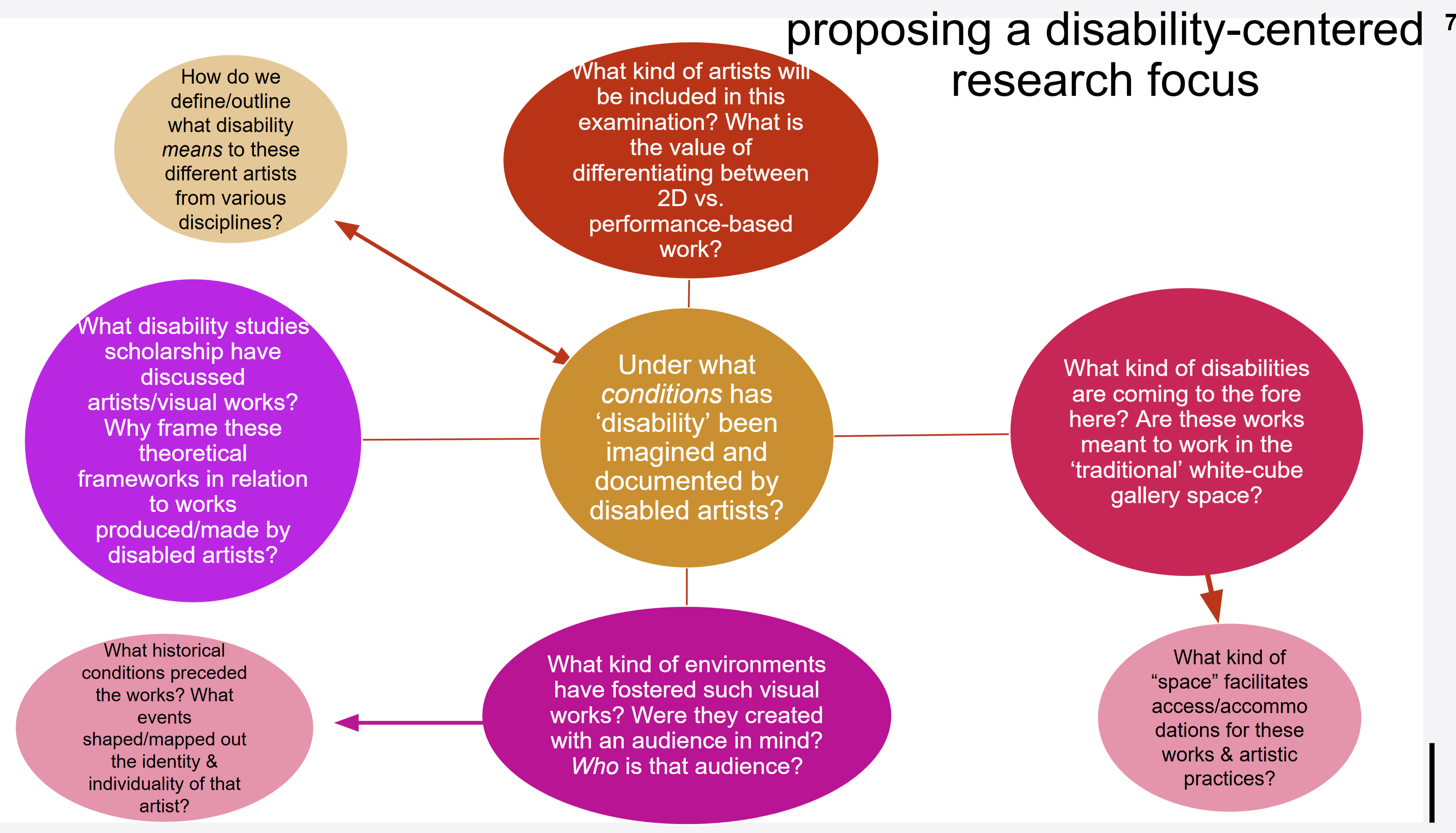
Let me preface by saying that a lot of this material was created for a project-driven goal — the class was based on students committing to a group project that addressed some theme/aspect of “the future.” Students at this point have done a lot of the heavy lifting, such as knowing methods for developing and building a thesis; using topic sentences in their body paragraphs; formatting a clear, cohesive introduction; finishing a conclusion with adequate information; and having practiced fair citation. At this point, I’m helping them get to more specific writing genres, like literature reviews, annotated bibliographies, lab/technical reports, personal statements, and so on. But the use of a research question/statement has been done with the idea that they have some kind of project shape or concept going forward — hence the map of questions that spring from a hypothetical creative-based project.
This can be adapted to other pursuits in research and writing, where students could start with a potential hypothesis/thesis statement. If I take what was previously mentioned about Get Out and the Sunken Place itself, maybe a rough mapping might look something like:
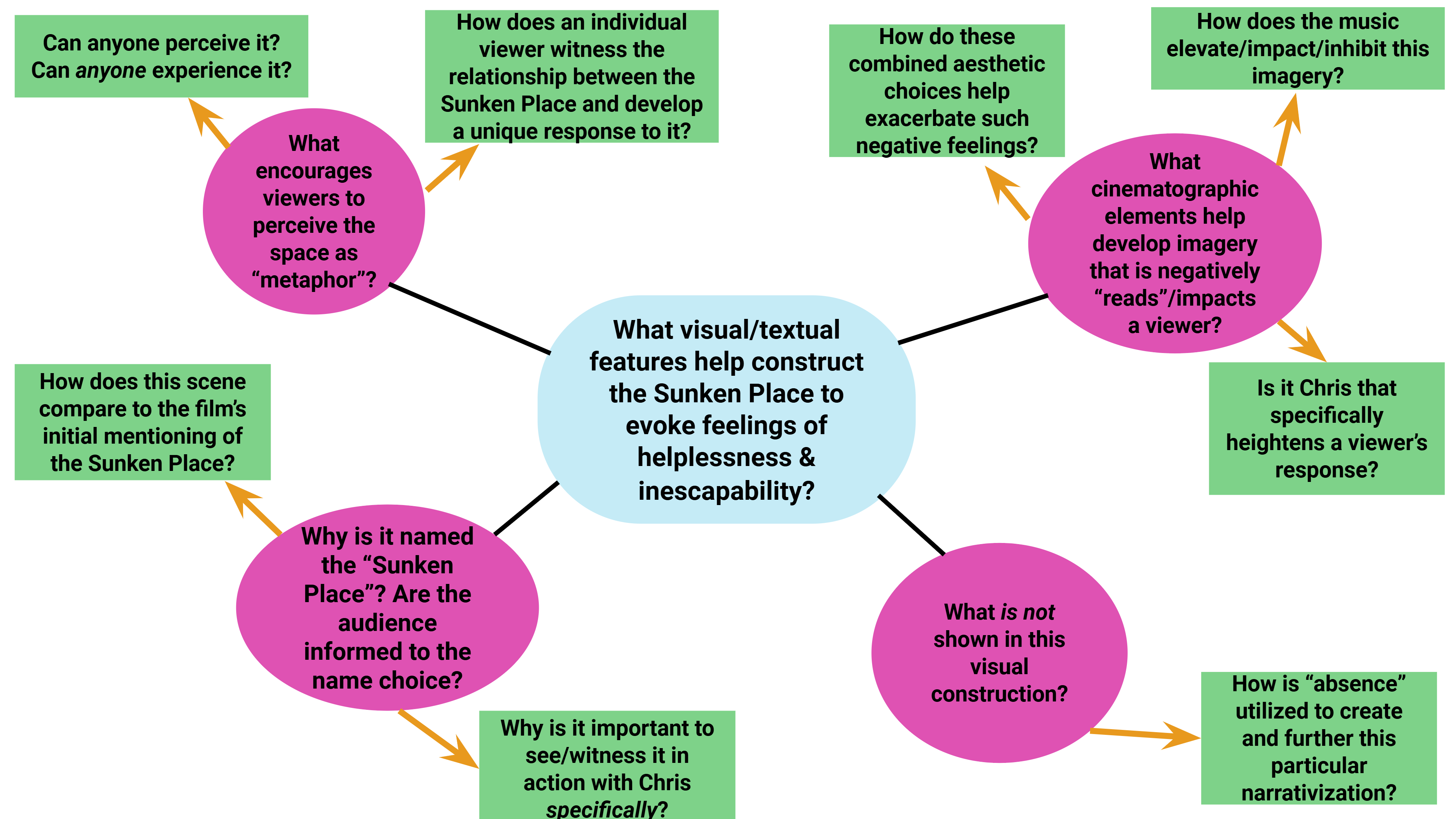
Certainly, worth mentioning that I have been doing visual & textual analyses a very long time — it’s okay that some students will not or do not consider every little detail. But what I show is how research questions are steppingstones, a big picture view, to get to the details and “nuance” of what might be a bit more interesting to take a closer look at. It can take time to get there! Like anything, routine practice makes it easier to develop beneficial strategies of thinking in different ways. It often happens that smaller, offshoot questions will go unaddressed or unanswered; sometimes those ‘random’ sub-questions force a scrapping of the initial project’s premise. The really nice thing is that there are potential “gaps” where future research processes can emerge and take place — whether continued by that initial student/researcher or someone entirely different.
I had every intention of continuing a closer review of research questions in this post but had not realized how extensive this already was (yikes!). In another post, I can talk about how I teach students to differentiate between a research topic and question (yes, I do backtrack at this point with instruction), and the parameters of what can help make a “good” research question — working with some of the brightest, most motivated, and determined students… this is something I am always prepared to address.
There is a lot of individual research and readings I should also find a way to focus on — such as my workcation being about having the pleasure of digging in museum archives (seriously one of the most fun experiences I have ever had) and writing through other topics I am still really interested in.
Until then!
X., D
Notes
- This writing may contain errors which I, unfortunately, could not catch; I wrote this draft while driving across state lines and had to bide my time doing something productive during the road trip. I apologize in advance for not catching any and/or all errors. ↩︎
- Here is an instance where I show students how language can determine the direction of their research. Consequences indicates something negative vs. outcomes which might facilitate a more neutral-oriented causal relationship. I am always mindful of this when I teach and let my students to understand this when I read their work! ↩︎
- There are pitfalls to student writing that I can elaborate on in a later discussion, and ways that I attempt to build strategies for them to grow out of these traps! ↩︎
- In some instances, students will use that “ample time” to procrastinate modifying grammatical issues and resubmit the same argument, expecting a different outcome. Spoiler alert: the assessment will probably be worse. ↩︎



Leave a Reply