

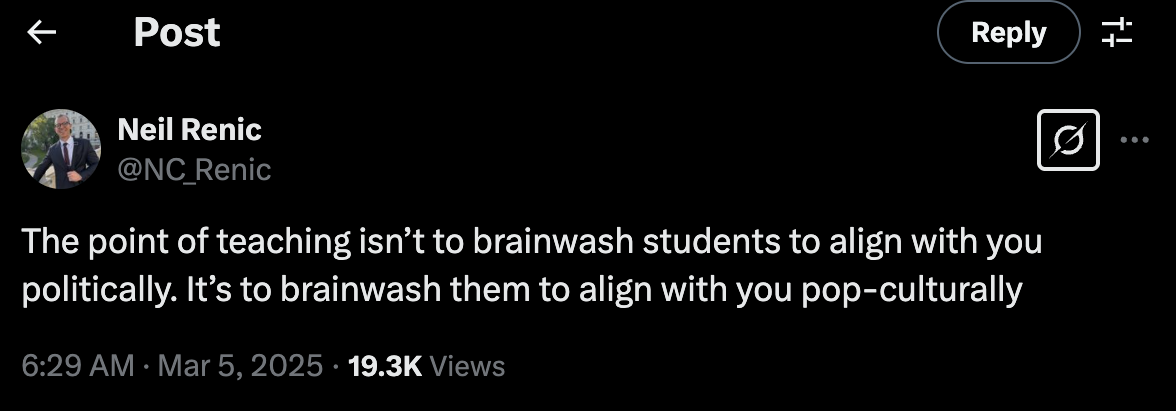
Student evaluations: where do we begin? Essentially, this is a dead-in-the-water conversation; as someone who has been on both sides of this responsibility, I can see why this administrative practice can disguise itself as a useful resource or facilitating tool. Without straying too far from the purpose of this post, I want my position to be known that the merits of the evaluation process is not my preoccupation. Rather, the fixation with evaluation in teaching presses instructors to assess, clarify, and understand their teaching philosophy. When I first started teaching, I was hyper fixated on my end-of-term evaluations every quarter: was I addressing students’ needs? What worked well? What was an experimental strategy that didn’t work out like I wanted? How can I incorporate suggestions without deviating from the already-proven successes of my learning environment?
While our institution has reworked evaluation forms, I find that they occupy less space in my mind these days. Partly, this is because I am aware that my teaching is rather satisfactory. I also understand that my enthusiasm, passion, and understanding of different lived experiences have produced an encouraging learning space where students feel a lesser need to perform a version of themselves that isn’t who they are. This is also because I spend so much time registering each student’s writing style and calibrating activities strategically for those needs. Is this feasible in larger classroom sizes? Dependent. I typically have > 40 students, averaging in the mid-30s, so perhaps this is a manageable population for me.
Disclaimer: Your mileage may (inevitably) vary.
It has been a painstaking process to extract what I believe my “teaching philosophy” is. Over the last five years, I have read sample teaching statements, participated in panel discussions about my teaching practice, discussed moderately reliable approaches to education and teaching with colleagues and friends, even explained these processes to family members, and written prospective teaching statements.1 There are probably many other conversations I have had over the years where I have distilled my teaching approach, whether intentional or incidental, and I hadn’t yet formulated concise principles.
So, this recent discovery was a purely accidental epiphany, thanks to my recent round of teaching evaluations. It was an offhand comment in a question section about ‘concepts to enhance’ — where students get to offer their feedback or critique about concepts, ideas, issues, or approaches to continue in teaching. I actually found a single comment immensely considerate because my student pointed out my teaching philosophy in such a uncomplicated manner. I recognized that they were reiterative affirmations that I always said under particular circumstances: after their first set of draft suggestions and feedback were released, when they received their first major assignment’s initial assessment (grade), during peer-review sessions, and when I gave my own examples of analyses.
The two phrases that define my approach to teaching writing:
- ‘There’s no such thing as bad or good writing.’
- ‘Tell me more.’
It hadn’t occurred to me that these were my foundational tenets in the classroom. On a deeper level, I am actually quite relieved that these are part of my teaching philosophy (pedagogy something-something), because I was indoctrinated with a writing culture that often proposed the exact opposite. I recall high school writing as exceedingly prescriptive: there is a ‘correct’ way to speak in your writing (never mind that these had become formalized preferences over time) and there are rules that must be obeyed. It took a long time to unlearn the damage from those AP courses, and now I have the advantage of unteaching them to a new group of students every single year. Teaching this method my first year was a frightening but liberating experience; going into my sixth year, I still find it to be equal parts terrifying and freeing.
Here, I’m going to discuss the first. I’ll dedicate another post to the second tenet.

Rejecting ‘Bad’ and ‘Good’
I have the same conversation with students every quarter — it never gets any easier or better to convince my students that the binary of writing excellence is an elaborate hoax. On some level, yes, I’d agree that “bad” writing exists in student writing; however, it never has anything to do with them.
Often these first-year students are subject to a startling but curious experience: they are an exceptional student amongst an entire community of equally exceptional people. They get scared, anxious, nervous, upset, and a plethora of other sensations when they feel like their worlds have collided with others, and on a macro level they feel unremarkable. While I notice that my students are encountering and confronting the cultural shocks of the university world, it seeps into their academic world. It really is not uncommon, year after year, to read introductory free-writes from my students that they no longer feel like the strong, confident writer that they were in secondary and/or high school. University becomes a competitive place and now they experience distress at their very real belief that they must always have some fresh, innovative, and groundbreaking ideas to even be in this environment. They believe that they haven’t ‘earned’ their place because they don’t know what “great” or “inspired” thoughts to entertain, never mind the reality that most — if not all — are only eighteen years old and have not received years of training to specialize in seeing, thinking, framing, analyzing, illustrating, and explaining material through their own voice.
Their apprehension to trust or even know their own analytical instincts reveals something fundamental: they haven’t yet realized they have analytical instincts to trust. Years of educational streamlining — the ubiquitous Five-Paragraph Essay, AP exam preparations, standardized assessments, and prescriptive thesis statements — have effectively trained students to demonstrate comprehension. And this is not a flattening of secondary and high school teaching practices! A very long time ago I was a ‘successful’ product of the very system that I now confront and critique. Yet now, positioned in the instructor’s position, I recognize just how long it took me to unlearn writing habits that were hammered into me in high school — some of which have become so fixed that I still have difficulty letting them go.2
However, the problem lies in the reality that high school writing does not promote interpretation. On one hand, they’ve mastered answering questions like “What do you know about X?” or “How do you know Y?” but have rarely been asked the fundamental question of critical thinking & deeper-level argumentative writing. “What do you think about ____ and why does it matter?”
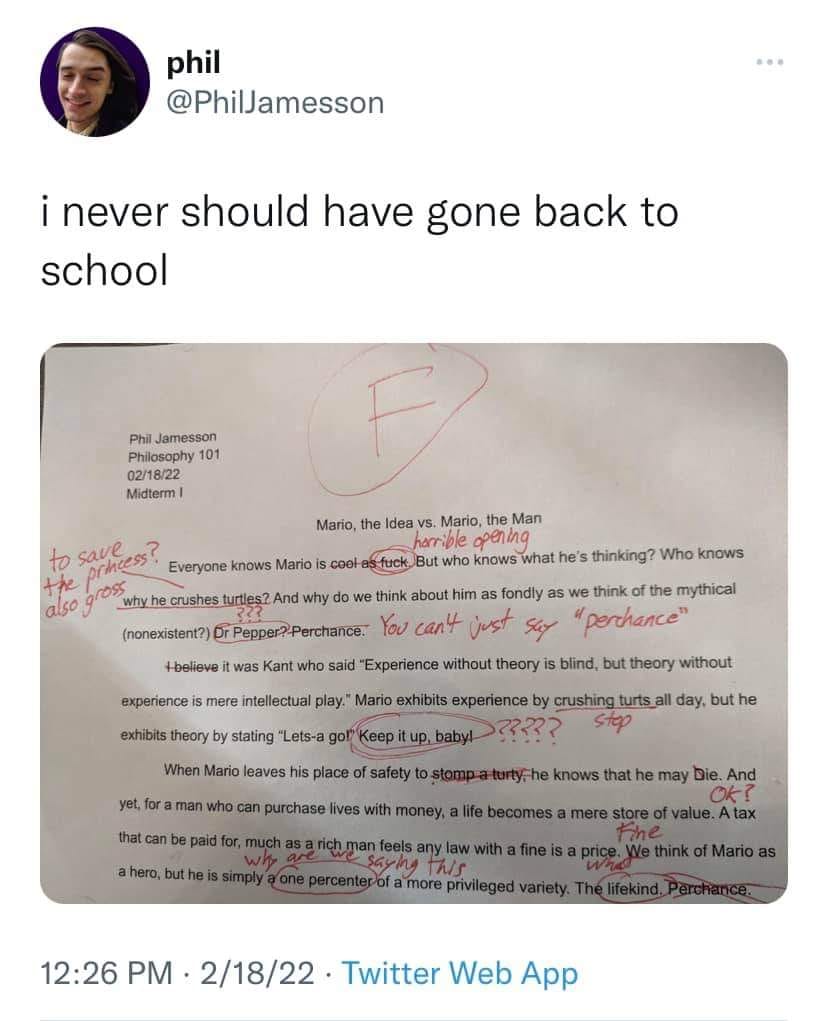
Now they’re immersed in a university environment that expects original thought (while simultaneously operating as a microcosm of broader societal hierarchies that commodify such expression), they experience shock. It isn’t simply inexperience, some students have approached and demonstrated unique analysis, but that their thinking suddenly has stakes they’ve never encountered. In my experience, many students view each paper as a performance of intellectual worth, and this distributes a power to other academic/educational pursuits: ideas are ranked, perspectives assessed for value, every discussion a competition for who belongs, and grades a market valuation of their mind. “College-level” writing isn’t just an academic shock but becomes an existential one. It’s strange to witness this turn, as well as concerning and overwhelming: their thoughts, which might have been private and personal, are now currency in an economy they don’t fully understand (or quite yet see).
The Writer’s Gap
This gap is where the “bad writer” narrative emerges: between what they’ve been trained to do (reproducing knowledge) and what they’re suddenly expected to do (produce knowledge). As an instructor, it is my continuous duty to build a bridge between the two — and yes, it is hard and messy.
Arguably, ‘bad’ writing has everything to do with their involvement and mastery of assigned material — and their investment in pursuing their own response and reaction to these ideas (creating their own original and unique insight). One of the first ‘actionable goals’ I put into action at the beginning of every year is to relieve their doubts about their writing; they aren’t “bad” writers, they simply haven’t yet learned to recognize their uncertainty as intellectual sophistication rather than inadequacy.3
What they interpret as ‘not knowing what to write’ (I used to hear this every quarter when I first started teaching, but now I’ve become adept at infusing possibilities early on in the term) is often the opposite. What happens is they’re overwhelmed by the competing possibilities they sense in a ‘text,’ paralyzed by their awareness of complexities they haven’t yet developed the language to articulate. Students who stare at a blank page aren’t empty of ideas, but typically wrestling with thoughts that feel too personal, too messy, too complicated, too tentative to commit to paper. They’ve internalized that academic writing demands immediate certainty, so they dismiss their generative moments of confusion as failure rather than doorways, opportunities to explore positions, viewpoints, interpretations, even feelings they aren’t sure they are allowed to.
The inevitable outcome is that students will immediately characterize themselves as ‘bad writers.’ And when students express themselves as ‘bad’ writers, I hear someone who has been trained to distrust their own intellectual instincts. They’ve learned to wait for external validation before pursuing an idea. Yes, as an instructor, my responsibility is providing guidance on what they can pursue — but I would never shame a student that they cannot pursue something unless they lack credible, satisfactory, and crucial sources to support their ideas. This is the delicate balance when teaching writing: students seek the ‘right’ interpretation, a version that they believe will earn them the highest marks, rather than developing their own. The perceived “badness” of their writing is actually the friction between what they genuinely notice and what they believe they’re allowed to say.
Yes, on the surface I’m teaching them useful techniques that will help them craft compelling grant applications and polished personal statements. These are the tools they’ll continue to use, certainly long beyond my classroom’s lifetime, to navigate systems they’ll inevitably encounter. I enjoy breaking the ‘bad writer’ trope with my freshman students because it’s a transformative moment for many of them. In the college classroom, they don’t have to “like” something; they don’t have to maintain a neutral perspective on a ‘text.’
Writing as a Radical Act
Fundamentally, I’m trying to help them understand their writing is not separate from their humanity — bear with me for a moment. Rather, their writing is an extension of how they inhabit, interpret, and reshape the world. Every argument they develop, every connection they make and articulate, every moment they push against a text’s boundaries, are not just academic exercises. These are practices of imagination and resistance, ways of insisting that the future doesn’t have to replicate the present. Perhaps this is overly maudlin, a saccharine way to prop up writing as a radical gesture, but my approach to teaching writing is to offer them a novel way of experiencing and living in the world through their writing and how an audience, reader, outsider, or community member will see them and learn who they are. So, when a student learns to trust their reading of a text, they’re learning to trust their reading of the world. They’re observing their authority to name what something is — is something profound? terrible? worth defending? broken? — and envision what could be instead.
After some time, I’ve acknowledged that my role becomes less about teaching them to write and more about giving them permission to think. I give them the space to value resistance to a text, their confusion about contradictions, and their ‘random’ connections to other materials (an early process to comparative analysis and synthesis) as the very foundation of scholarly inquiry. In this sense, teaching first-year writing is about cultivating the kind of collaborative, creative thinkers who understand that knowledge isn’t property to be hoarded but a commons to be expanded; arguments aren’t weapons to systematize ongoing competition, but tools for collective understanding.
For me, these are the individuals who will build futures worth inhabiting. They do not earn this through having mastered the ability to write ‘well’ by some arbitrary standard, but understand that their perspectives do matter, their questions are valid, and their words can and do reshape the spaces they enter.
The Question Behind the Question: The Superman Problem
“All this philosophy about radical acts and reshaping worlds — well, what does it actually look like?” Let’s start with a sixteen-year-old trying to write about Superman. (Side note: I actually love that I get to teach writing through an interdisciplinary lens that often combines pop culture with different theoretical frameworks!)
Recently, my younger brother — a high school junior — asked me for advice. It wasn’t something routine like what he should eat for dinner or if his outfit aligned with his ‘style,’ but writing. I love when those closest to me ask about teaching, but I found it particularly satisfying that my younger brother was genuine in his questioning (primarily because how often do I get the opportunity to converse with my pseudo-uninspired and slightly alienated teenage brother whose interests lie in video games and social media than post-secondary school dialogue?).
But when he told me about his English assignment, I saw this transition play out in real time. His English teacher had assigned a short writing response about Superman and Batman; he informed me this had originated with a student’s revelation that they had finally watched Batman v Superman: Dawn of Justice. His assignment seemed standard: analyze whether Batman or Superman was ‘good’ in the film. There was no need to do comparative analysis, although his initial instinct was to describe how one character was more morally compelling than the other.
My first question is asking the student what they found compelling — but it can be anything similar, like interesting, peculiar, odd, wrong, ambiguous, etc. But I always try to highlight a student’s own decisions. My job isn’t to guide them to what I think merits analysis or what they think I will want to read; what I want to stress to students — like my brother here — is that this is about their position, choice, belief, opinion, idea, and so on. Students will look to you for reassurance that they’re on the “right” track, and I always make it visible for the student that I am interested in their ideas — I’m just here to help them find substance to amplify what they already have!
My brother informed me that he found Superman to be a great example of ‘good’ in the film, and he’d already isolated a key scene that he felt would be good support: Superman staying behind after the Capitol bombing, then self-exiling in response to his failure to save innocent lives. His initial thesis was perfectly competent high school writing — “The aftermath of the congressional hearing bombing shows how Superman remained behind to do what he felt was the right thing.”

But this is exactly where high school writing typically stops — identifying and naming the interesting component. This signals to me ‘Look, I noticed the important moment!’ And this is a great foundation for students to have, demonstrating that they are capable of critically reviewing something — an object, a text, course material, etc. — because it illustrates they’re not simply paying attention to a detail. Rather, their ability to identify should be treated as their writing infrastructure: without this organizational system, their analysis will not function properly to get their reader to ‘see’ where and how they’ve come to that decision.
However, college writing picks up from here, beginning with the question that many students have not been trained to ask: Why does this matter?
I’ll admit — this part can be difficult to accomplish. I have had students who crack, who dissociate, who perk up, who grow hostile, and others who make a show of interest. It happens. It isn’t my responsibility to make them care about my pressing, but my job is to hold them accountable to the expectations of the course’s learning objectives: understanding writing as a process (which includes brainstorming, reflection, and multiple drafting sessions), learning how to ask constructive questions, learning the components of an argument, and practice writing as a learning strategy (including how to read, summarize, and respond to arguments). This means that Why does it matter? becomes a training tool for them in the classroom on how to accomplish these objectives, but also a guideline as they move forward in other courses.
I always preface that they’re off to a great start, but then I start to push. So I began to push my brother, much like I would my own students.
- Why is this most the strongest evidence of Superman’s goodness? (Alternatively, I’ll tell students — Why is this moment the strongest evidence to them of Superman’s goodness?)
- Why does him remaining behind matter? (Or How does him remaining behind demonstrate something specific? What is that?)
- Why does his self-imposed exile signify goodness rather than cowardice? (What specifically in this decision to self-exile illustrates/demonstrates goodness?)
There was something that clicked for my brother here. By asking these questions, we arrive somewhere far more interesting. My brother explained to me that he found it interesting that Superman responded to his failure in a very ‘human’ way: his goodness emerges not from his alien strength or his infallability; rather, my brother suggested that it comes from human-learned behavior to be held responsible for this act. Superman holds himself accountable for deaths he couldn’t prevent, accepting the responsibility that is neither legally nor logically his. For my brother, he was pinpointing Superman’s goodness was inherently linked to the moral weight he bore for humanity: his shame reveals Superman’s experience as deeply personal, carrying the load of making choices that are not for himself. He could have saved them (he has powers!), therefore he should have saved them (possesses a conscience). Our conclusion was that Superman’s goodness is that his self-imposed exile reflects the burdensome reality that Superman feels both at fault and responsible for these deaths (his emotional reality).
As we held this conversation, we watched the sequence a handful of times. I told my brother, like I tell my students, it is always a good habit to practice re-examining and studying examples as many times as possible. The more you watch, the more you see. And the more you see, the more you realize you’ve missed a crucial detail, an imprint that helps sketch out your argument. He began to notice new details everytime we rewatched it: Superman’s disappointment in his brief headshake in the fiery aftermath; the slow blinking at his growing awareness of what’s occurred; the tears growing in his eyes as he looks down. My brother argued that this final shot of Superman’s glassy eyes, only looking down before him, makes it clear that Superman is filled with guilt: he does not bother to actually look around at the destruction around him, his gaze cast down tells us that he knows the horror that surrounds him — his ‘alienness’ falls away when we see his vulnerability, incapable of facing the devastation that lays around him. Here is where his goodness actually lies: his suffering reveals the depth of his hurt, the pain he’s undergoing amidst the unnecessary casualties.
This was actually a teaching moment for us both. For my brother, he begins to understand the different levels of writing as he moves forward with his education journey. For me, it’s another reassessment of my strategies in engaging student writers.
But this is the leap from What happens? to What does it mean that this happens? Together, we worked from proving that he watched the film, that he can pluck out details, elements, or signs that ‘prove’ something to arguing about how issues like heroism, guilt, and moral responsibility function. The key takeaway here is that my brother had all of these insights! But what I find to be the most exciting part of my work is to give them the space to trust that insight, those ideas and opinions, as legitimate avenues for analysis. Often students feel that their personal feelings — whether it is about a journal publication, a genre of music, a film, an art object, and other works/texts — are not openings for analysis, or that they cannot ground those observations with ‘credible’ evidence.
Their hesitation is that they’ve been misguided in that their insights are not “academic enough” is exactly what paralyzes many first-year students. And I find it thrilling to smash this misconception to death the first instance I get.
When all else fails, I find prompting students with Why? is a great start. The student who thinks they’re a ‘bad’ writer is usually someone who hasn’t been asked the right question. Once they realize their uncertainty and confusion transform into complexity, their hesitation is careful thinking — that’s where the real work begins. And students shouldn’t feel the pressure to perform to unrealistic expectations, but they do need the space to discover what they think and why it matters. And honestly… watching them realize they’ve had important things to say all along — from insights about Superman or systematic oppression or the cultural inconsistencies of the 1990s — is why I love teaching. I’m not giving them freedom. Rather, I’m showing them that they already have it. 4
Notes
- Author’s note: attempted to write a (coherent) teaching statement. Good thing I’m not on the (probably non-existent) job market at this time. ↩︎
- While the 1:1 quote-to-analysis ratio might serve as a helpful beginning framework for teaching students to prioritize their own voice alongside outside sources, it reduces meaningful analysis to a mathematical formula — to complete X on one side of the equation, you must do Y as well. Yet I still feel its gravitational pull (thanks a lot, College Board!). My high school English teacher was a disciple of the refrain “For every line of quote, you should have one line of analysis dedicated to explaining it.” It is unsurprising and frustrating that “Did I analyze this enough? Are there enough lines of engagement to meet the ‘quota’ for meaningful sentences explaining it?” can often sneak up on me when I am deep in my own work.
So, I frame this motto differently for my students and myself, particularly with the hope that I can shatter their own possible misgivings with writing as much as I can dismantle this unconscious demon every time I sit down to churn out my own research. Rather than feeling like I need to give X explanation statements and Y analysis sentences, I now recognize that sometimes a brief, incisive comment about a key concept might be as powerful as an in-depth interrogation of a brief passage. This admission shows my students that I, much like them, are wrestling with these same programmed habits. And writing is always an ongoing learning process. ↩︎ - An excellent way I combat this is by being grounded. Students often hold unrealistic expectations, whether of the particular type of educational experience they have been convinced they’ll have or the level of ‘proficiency’ they hold themselves to. I teach at an R1 so it should be unsurprising that a majority of my students are habitual overachievers who are anxious about maintaining their GPA while surrounded by other exceptional students from around the world.
Every week it seems that I inform students that university is a place to intellectually grow — and this can take on differing interpretations for their goals. What are they hoping to gain from their university experience? For every student, failure is inevitable; when one fails, they acknowledge that there are limitations — and we can learn to push beyond them in a reasonable manner.
When even this perspective doesn’t resonate, I remind them that their designation as a “student” is no different than mine — I learn, adapt, change, and reorient myself, my research, theories, methodologies, analyses, ideas, and processes in order to continue moving forward. The goal isn’t that they feel small in comparison, but that they witness that I am not infallible — so why should they be? ↩︎ - Apologies for the delay in my posting — it’s been a rough end of summer for us. I’ll hopefully go back to consistent posts in the upcoming weeks as I have lots to discuss. ↩︎




 the desire to be dissolved
Leave a comment