As my PhD journey nears its end (though it still feels immensely distant), I’m struck by how far my research has strayed from traditional art history. Despite the discipline’s entrenched rhetoric and old guard legacy, one thing remains constant: my perspective as a Millennial, shaped by the unique cultural landscape of the 90s-00s. Now, in an era of rapidly evolving social media and digital communication, I find it essential to write, communicate, and critique in ways that resonate with audiences who, like me, were formed during that pivotal transition between Gen X and Y sensibilities.
As I confront the question of ‘Who am I?’ as a scholar and thinker, I’ve realized I’m no longer just a specialist in pre-Contact Mesoamerica. While I don’t claim to be a ‘voice of a generation’ (the melodrama), I am committed to entering conversations that allow me to think across theoretical and ideological boundaries — drawing from my experience of anxiously coming of age in a transitory space within an increasingly unstable but transnational world.
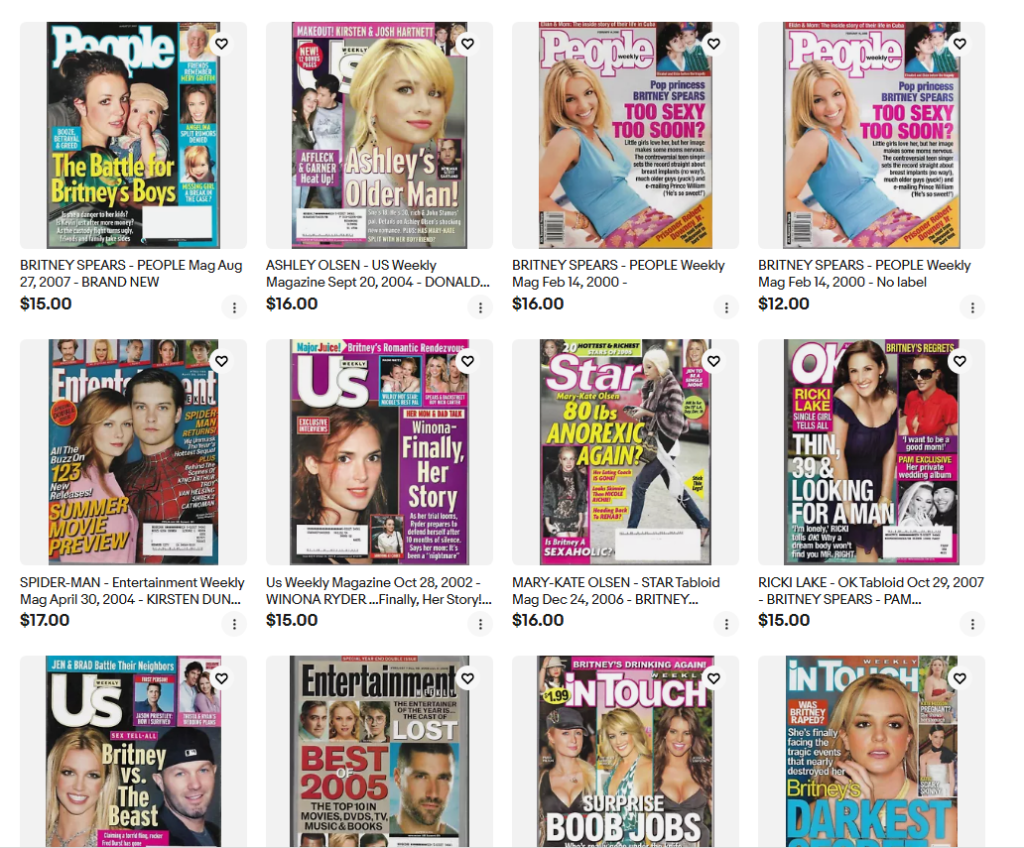
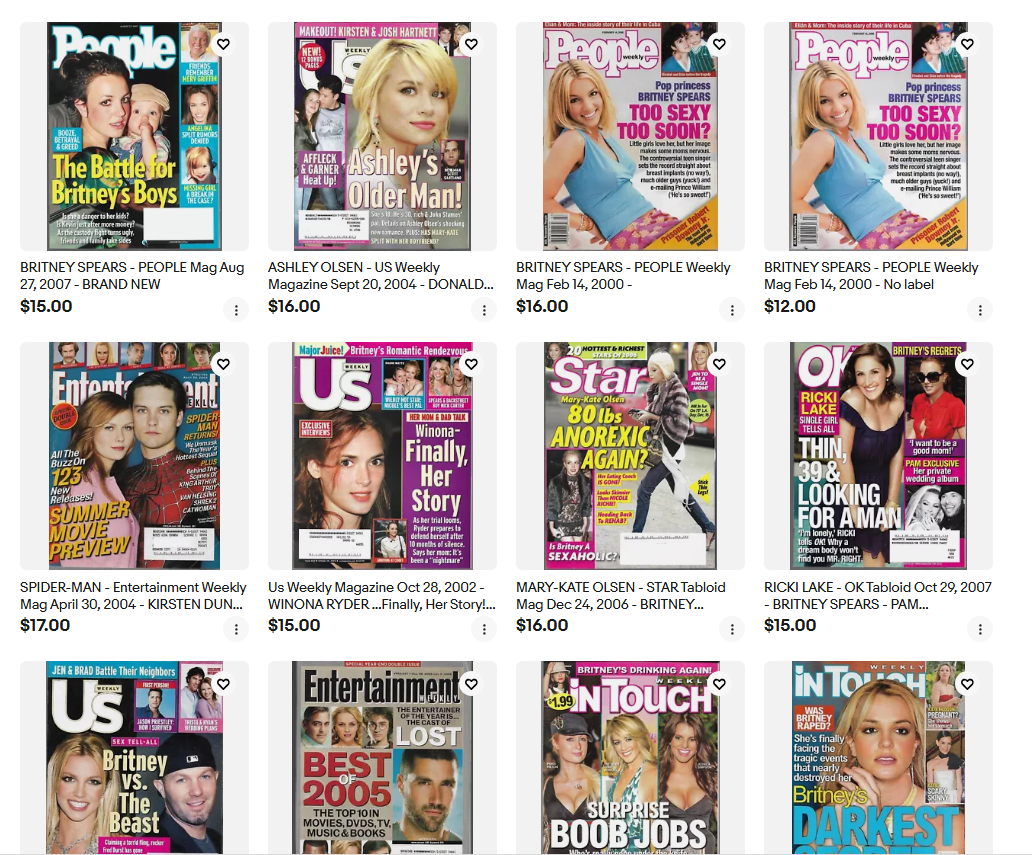
The late 90s and early 2000s were an interesting cultural landscape. And given that most of my students were infants at the birth of portmanteaus like sexting or crowdsourcing, they have questions about the world of the early 2000s.1 I was very much so (and still am) a child of gossip magazine and tabloid culture. My mom worked in a doctor’s office when I was a tween and when I ran out of books to read, she would bring home the old magazines (they would go to a landfill at some point, but they had a prolonged life hidden in my closet, behind my eclectic mixture of knock off dELiA’s & Hot Topic wardrobe).2 I will spare some of the autoethnographic details here, but I truly was a child and remain a byproduct of this period: I devoured these magazines throughout the early 2000s when I probably had no business allowing my self-esteem to subconsciously become woven with these publications.
For fellow academics, there’s this intermediary period3 in your PhD program. You’re not quite a student anymore: you have taken the required coursework that’s expected and asked of you and now is the time to prove that you are worthy of the ‘candidate’ status. You’re also not exactly an expert because you’re still evaluating what your dissertation project will look like, how it needs to be formatted, what kind of resources and evidence you’ll need to ‘prove’ that you are worthy of that PhD designation at the end of one’s name. A big part of being a PhD holder is becoming someone who is adequately capable of disseminating information and knowledge to others — you are learning to teach, but you have to have some idea of what knowledge is productive and deserving of being communicated.
Being asked to create hypothetical syllabi is a practice that I consider to be both challenging and creative. I created my first hypothetical syllabi in 2022, “(Un)belonging – Performance of Self: Indigeneity, Brownness, Blackness” while rereading Muñoz’s The Sense of Brown — produced in a moment when I felt vulnerable in my PhD journey’s earliest stages. I found a space to quasi-comfortably possess in the posthumously pages of his writing, where I routinely asked myself (and have asked myself), “What does it mean to be Brown? What does it mean to feel Brown?” Roy Pérez wrote a comprehensive and genuine review of Muñoz’s work and the legacy that he has left behind, and the part which seemed to linger with me, burning into me was the following excerpt regarding the shift from ‘feeling’ to ‘sense’:
In The Sense of Brown’s later essays, where Muñoz engages with the work of phenomenologist Jean-Luc Nancy and the poet and philosopher Fred Moten, the author figures brownness as a commons — a shared space of both racial abjection and political vitality to which minoritarian subjects can attune themselves and become what Nancy called “being singular plural.” Muñoz’s shift from feeling to sense might seem like a split hair, but it represents a pivot through which the singular subject can be envisioned as part of a commons made up of multiple, attuned selves and their histories. Feeling and sense are two vectors of relation toward a network of shared experiences of racialization. If feeling is the immediate experience of being racialized — inward and reactive — then sense is about sharing, touching, and experiencing that feeling in the immanence of a collaboratively fashioned commons. Muñoz’s shift to sense adds precision and complexity to the affective life of race.
— Roy Pérez, More Nearly: On José Esteban Muñoz’s “The Sense of Brown”
My identity as a Latina, raised in a culture of community and family-centered care practices, seemed perpetually at odds with the mainstream discourse of American individualism. The illusory spectacle of the ‘American Dream’ and meritocratic identity-formation felt like I had missed something during my formative childhood years: I was not simply raised wrong; I was immediately displaced from success and ‘achievement’ from the beginning because my entire identity and sense of self was threaded with the complexities of others’ well-being and identities.
What Muñoz revealed in his posthumous work, as Pérez points out, is that such identity formation processes are neither imposed nor individually experienced; rather, they create a generative space of connection and shared consciousness. Certainly, we should heed the call that the process of racialization can and does offer us a moment of collective action and resistance. What I found so poignant about The Sense of Brown is its insight into how individual and collective identities are inherently bound and interwoven: ‘sense’ operates as a dimension of relationality that touches upon both the immediate, internalized feeling and the broader commonality of experiences affected by social and political structures.
Understanding identity as simultaneously personal and collective transforms how I approach knowledge production in academia.4 I think it’s important to really emphasize how the relational nature of ‘sense’ isn’t just a feature of my theoretical framework — it isn’t simply a matter of grabbing different methodologies and saying, ‘I’m a different scholar, see? I’m interdisciplinary and inclusive!’ Rather, this concept of “sense” shapes what knowledge should be worthy of disseminating as an emerging scholar (gulp);5 something which academia has long forgotten is its contradictory place in society — it’s an institution that should be a space of individual pursuits that actively shape collective experiences and well-being. It’s important to recognize honoring individual experiences in such a way that they can trace their foundational support and interconnectedness to broader communities and structures (something we seem to have lost sight of). In this way, The Sense of Brown offered me many things, but mainly: one, a theory of identity that helped me ‘find’ the importance of the anxieties and complexities that make me incapable of addressing ‘Who am I?’ quite neatly; two, it’s a methodology for ethical knowledge creation to place under duress the individualistic tendencies that continue to shape traditional academic discourse.
I will admit that I am very much so unashamedly a byproduct of the 90s-00s, and I think it’s key to keep some of that historical period’s peculiarities alive and well in my ongoing academic journey. I realize now in my later age that my identity is informed by the dilemmas of growing up during Y2k era and learning to oscillate between remembrance and humiliation of the things we did, saw, explored, heard about, listened to, watched, wrote about, discussed. It’s also a little embarrassing to admit that I was a ‘chronically online’ teenager, a symptom of a former ‘had-no-business-doing-that’ child exploring the early WWW. In between AP and honors class work, I would scroll through gossip blogs. A prevalent opinion during the early 2000s was that celebrity gossip was certified brain rot for the masses, but a practice which everyone pursued in secret. You couldn’t help yourself: you had to grab the National Enquirer and read Yolanda Saldívar’s confession or read the Globe’s coverage of heartthrob Leo DiCaprio’s nude photo scandal.
I look back now at pop culture and celebrity gossip from the 90s-00s and I think the designation of Internet culture during the early 2000s as the “Wild West Web” is a rather appropriate description. The problem isn’t that it was a lawless, decentralized space that cast its shadow over reality; rather, the true consequences of the online world being this immaterial environment is that there couldn’t be ‘guardians’ of the space who could regulate the space with honest, moral intentions. At this time, we were living in a post-9/11 world, riddled with anxieties that drove us to be hyper nationalistic patriots who were attempting to safeguard and police what little vestiges of perceived ‘humanity’ we had left. When the 2007-2008 financial crisis hit, economic insecurity intensified our complicated relationship with wealth and status — the precariousness of our financial situations became inextricably linked to social danger.6 Celebrity culture stood as this festering wound that savored its lewdness and depravity — a convenient distraction from systemic failures and a canvas for projecting our collective moral anxieties. It was a world where surveillance was not just a willing compromise; it was a nonnegotiable — and celebrities lived under that willingness to be scrutinized and dissected for their failures to being ‘good’ citizens. The true consequence of early 2000s mainstream and popular culture was that it became an inherent, self-indulgent part of our identity that we were now ashamed of having absorbed within ourselves.
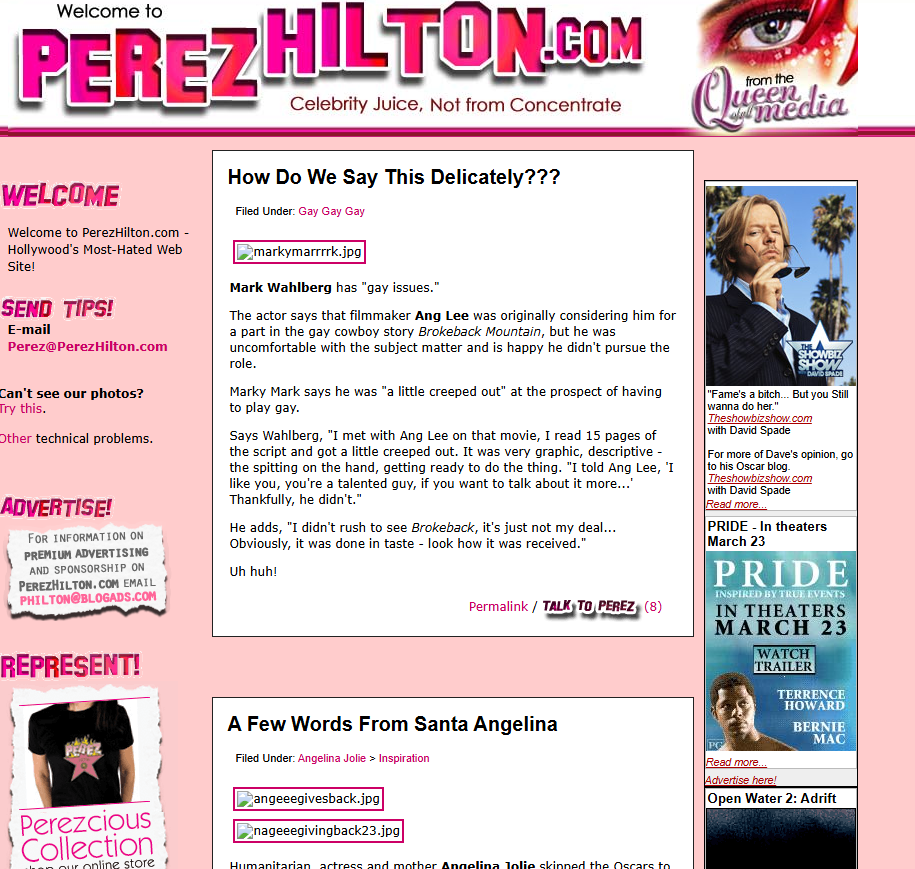
I started reading Ditum’s Toxic: Women, Fame, and the Tabloid 2000s (2024)7 about a week ago, which brought me back down the proverbial Memory Lane of when I was a ‘problematic’ teenager, invested in the vile drivel of gossip blogs. I have my objections, but I think it produced a renewed interest in something which I am still very much so guilty of: I still read celebrity gossip at best every other day — if not every other day, it’s often at least 30 minutes in the morning while I drink my coffee and prepare myself for teaching and research. But when I was a teenager, I flocked to gossip sites like perezhilton.com, dlisted.com, laineygossip.com, CDAN, ONTD, and probably a few others. Reminiscing and it’s evident: we were terrible people in the early 2000s. We don’t just owe apologies for how we treated celebrities and weaponized their publicity as spectacles of perceived sociocultural failures. We need to pierce into why our coping mechanisms during this anxious and unstable moment in time encouraged us to cause such destruction upon other human beings (whatever problems we might and need to discuss regarding class and wealth disparity). We can’t ask forgiveness for building communication technologies that prioritized brutality against the popular icons; rather, we could begin with determining how we can avoid circumscribing our identities through such trajectories that strip individuals of their humanity for our cruel pleasure and entertainment.
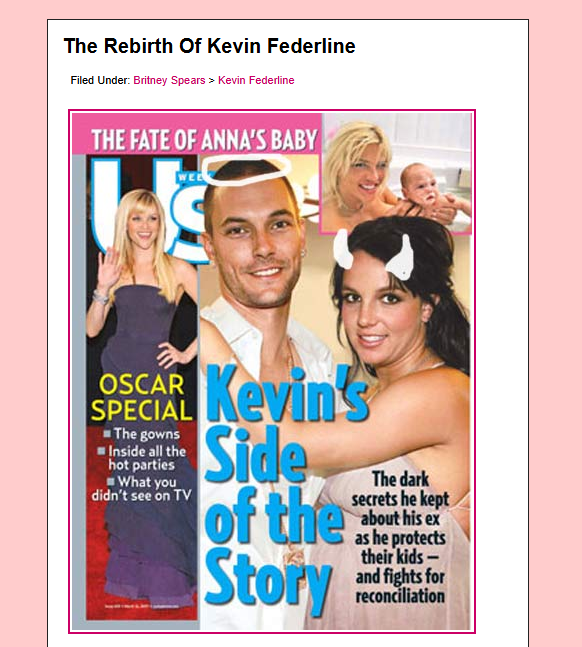
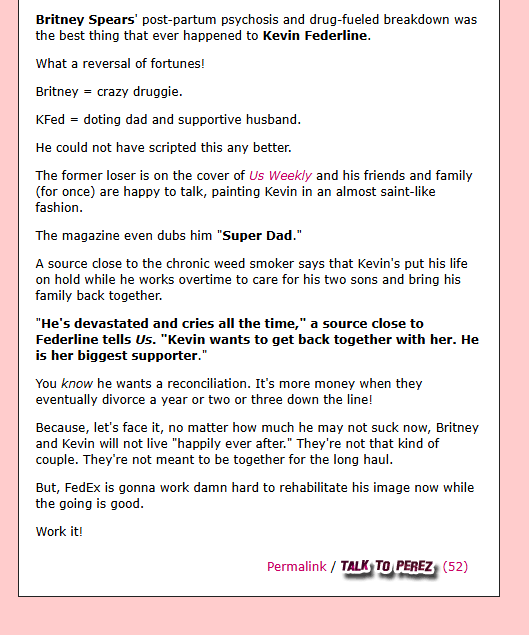
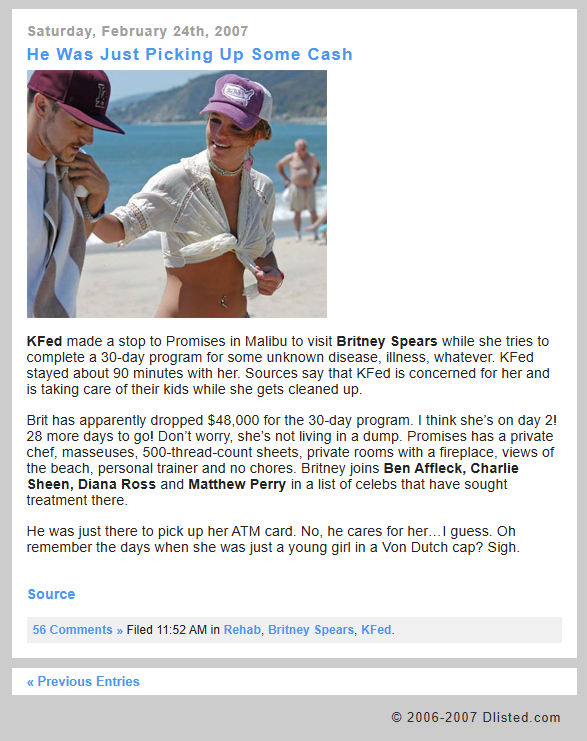

The first chapter is a case study on Britney Spears. I was never a certified Britney die-hard aficionado,8 but I certainly did purchase all of her studio albums with whatever disposable income I had left over. One thing which struck me in Ditum’s chapter is the slightly tangential excerpt on JT’s ‘Cry Me a River’ and the relationship between the limelight, control, and punishment (or at least this is my perception on the passage). In it, she writes:
(addressing the intentional Britney Spears resemblance in the ‘Cry Me a River’ video) … if the pout and long blonde hair don’t give it away, the fact that she wears Britney’s then-signature baker boy cap throughout should be enough. It’s a fantasy of invasion as punishment: if a woman was assumed to have failed at fidelity, she was assumed to have forfeited her boundaries altogether. Trespassing on her home was no trespass at all if she had shown herself willing to let other men through the door. If you can’t keep your legs together, you don’t get to complain about someone jimmying your lock. Or about a paparazzo aiming a lens between your thighs.
— Ditum, “Britney: Fame,” in Toxic: Women, Fame, and the Tabloid 2000s, pg. 9
First, I will admit that I have always been utterly convinced of JT is and has been a pompous, narcissistic, self-absorbed, deceptive garbage bag. His entire identity was fabricated in selling himself as a byproduct of Britney’s transgressions; JT did not simply project himself as an antithesis to the bubbly pop star’s now crumbling virtuous image (that had been shaped by her presumed chaste disposition), but he constructed his capital around publicizing intimately private wrongdoings that the world deserved to see — they had been lied to. Slut shaming aside, this moment in Ditum’s writing provoked the awareness that our culture is so inherently interested in the deliberate forfeiture of privacy. Being a public figure endowed the masses to an entitlement to their very existence. And it isn’t just this abandonment of privacy or separateness between one’s sense of self as a spectacle and one’s sense of self as a non-spectacle, but it’s the way we glamorized this aspect of society in our culture to be ‘okay.’ Certainly, yes, it is a quandary: faithfulness, loyalty, fidelity, devotion, monogamy are all ideological issues that are played out in mainstream society; the insidious underbelly of this problem between JT and Britney is asking ourselves: how much of these private, intimate affairs are worthy as public performances?
This is where I have found myself as I begin to determine my own imagined syllabus: an intersection between the deeply personal and a necessary trajectory of knowledge production. I am envisioning a class that investigates the ongoing narrative that ties notions of fame, notoriety, publicity and voyeurism to ‘celebrity culture.’ I think what I am ultimately invested in is tracing how public scrutiny and media narratives become mechanisms of control, paralleling the concept of ‘hysteria’ in the 18th century. A lot of this rests around observations within the last 3 years around Britney, but as someone who grew up in that tabloid frenzied era it happened with alarming frequency to other women celebrities — some who were destroyed by the media and paparazzi. Anna Nicole, Amanda, Brittany, Monica, Amy, Sinéad, Whitney. It’s most recent victim: Megan Thee Stallion. Men were not exempt: Paul Reubens and Justin Bieber are part of that pattern of, when necessary, our culture is an equal opportunist to discipline celebrities under the guise of ‘entertainment.’
For now — I’ll take recommendations, if anyone has any.
I have some possibilities for where this might go (stay tuned?) and how I am trying to construct this class. If there is one thing an academic has to learn to do, it’s adapt pre-existing material to different departments (without doing too much work because we’ve already done enough, right?). I’ll leave a final comment that seems to do a great job in capturing a brief glimpse of what pop culture was like by the late 2000s.
“she really is batshit insane. and obv it doesn’t help to have crowds of people gawking at her the whole time. but she really brings it on herself by living out her life so publicly and doing these crazy things all the time.”
* Another title I had for this was “Confessions of a Former Tabloid Teen”, but I figured that was too on-the-nose. And I’m a former teen, certainly not a reformed gossip follower. What else would I do to break away from, well, academics?9
- I recently learned that the early 2000s are commonly referred to as the ‘aughts’ or ‘noughties’ outside of the US. I have always referred to this decade as the early 2000s or the start of the twenty-first century, so it’ll be interesting how I adapt some of these linguistic choices when I begin discussing or teaching this period. ↩︎
- I was a pseudo-rebellious preteen — it’s hard to rebel against parental ‘authority’ figures when they allowed and actively encouraged you to be who you were and wanted you to be whoever you could. I mentioned this in a previous post, but I am thankful to have had immensely liberal and open-minded Latino parents that gave me freedom, love, encouragement and space to form my own identity. ↩︎
- There’s also another during year 3-4 which I call the ‘existential crisis’ — or the “sunken cost” dilemma. Every PhD program will vary, but it’s often the moment in your program where you question “is this really worth it?” and start fighting for your life in academia. It’s an opportunity to reflect on whether some of the perceived (and valid, which I speak from experience) troubling conditions that are interlaced to ‘the academy’ are worthy violations to pardon for what comes at the journey’s end. I have my grievances with my department, program, university, and the disembodied institution itself but I digress. The point is: evaluating whether the actual cost supersedes the sunken cost (and the sacrifices made to get to this decision-making moment) is subjective and dependent upon the destination at the end of this tunnel. AKA: your mileage may (and will) vary. ↩︎
- Many thanks to the wonderful assemblage of individuals who sit on my committee who have always grounded by research back to this premise: what does it mean to be human amidst all of these chaotic processes, interventions, structures, and experiences? ↩︎
- Author’s note: given recent political tidings, not entirely sure how this will look within the next 1-5 years. But I will say: I will continue to persist because I have plenty to say and lots left in me. ↩︎
- It isn’t lost on me at all that The Big Short (2015) represents Hollywood’s hollow critique of the catastrophic failures of lawmakers and the predatory practices of Wall Street during the housing market crisis. This film packages real human suffering — millions of working-class Americans who lost homes, savings, and livelihoods — into slick entertainment starring grossly overpaid actors. The supreme irony: a movie about financial exploitation becomes itself an exercise in profit-making, offering viewers emotional catharsis without advocating for any material change in the conditions that caused the crisis or preventing where we might go next. The film’s very existence as ‘entertainment’ trivializes the ongoing economic devastation it purports to expose. While meta commentary in film could potentially serve as a powerful tool for social critique, it seems unlikely to deliver valuable, vested material when created by the very hands that profit from the continued disparities and struggles of working-class individuals. This contradiction should ring clearer than ever in our present political situation, where entertainment often masquerades as activism while the systems of inequality it depicts remain firmly entrenched. (Can you tell that I hated this fucking movie? Because yes — yes I absolutely did.) ↩︎
- As an academic, I try my best to suspend some of my ordinary reading habits and expectations toward non-academic genre publications. Given that so much of my reading practice is structured around the traditional academic publication model (“here’s my primary object, here’s the theoretical/methodological framework I’m using to examine that object, oh look some of the previous literature and some of the limitations or impacts of these conversations I’m writing into — okay, here’s my vested interest in why we need to re-examine the primary object’s role from its initial intent or impact.”), it can be immensely difficult for me to read texts that don’t have an extensive ‘Notes’ section at the end of the book. I figured this book would be an adequate platform into some of the issues I’m interested in examining regarding popular culture, tabloid aesthetics, and themes like surveillance, identity, notoriety, and spectacle. I am about ~22% through this reading and I think I can comfortably say this is a 2.5-3 out of 5 stars. You can follow along on my reading journey on Goodreads (if that’s something which people still use — I just rediscovered my password and profile). ↩︎
- Interestingly, I did run a successful Gaga fan site right prior to her achievement of global stardom. My husband teases me about this endlessly, mostly because I am incredibly passive these days. Once upon a time ago, I truly was “that” girl on the internet. ↩︎
- This is also the best way I have learned to begin to work beside my grief. In a little more than a week, it’ll be two months since we lost our eldest girl, our princess Ozilla. Life has been brutal. Burying myself in work, research, reading, excavating the past, nostalgic reminiscing, and trying to fight through my mental disorders has kept my crying to twice a week. A moderate success, but it’s one I wish I didn’t have to live with. ↩︎




 the desire to be dissolved
Leave a comment